Happiness is an inside job.
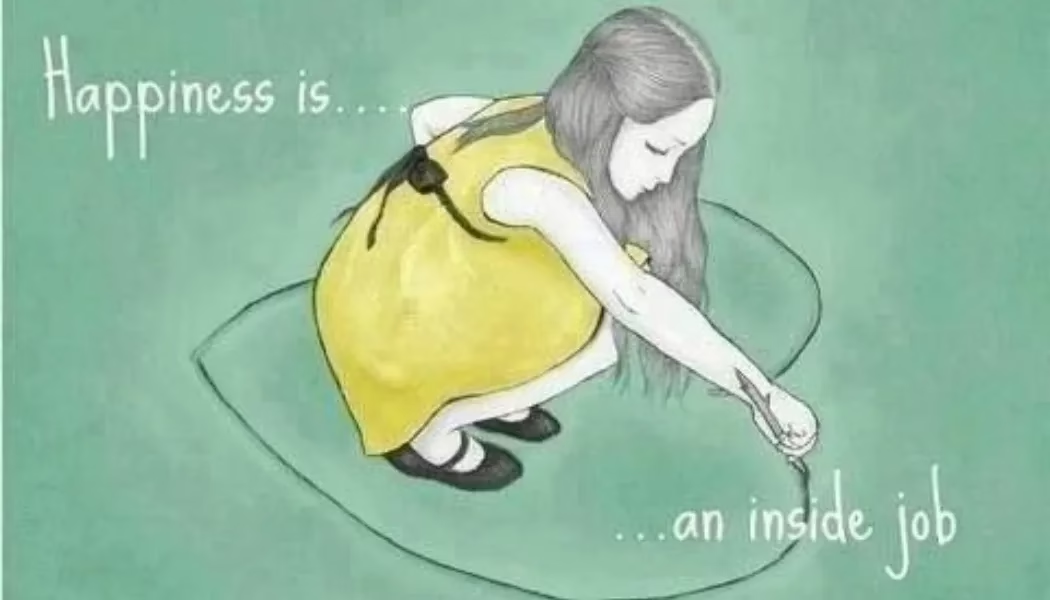
There is a quiet moment in the illustration: a girl in a yellow dress, crouched gently, drawing a circle around herself. The words float softly nearby—“Happiness is… an inside job.
There is a quiet moment in the illustration: a girl in a yellow dress, crouched gently, drawing a circle around herself. The words float softly nearby—“Happiness is… an inside job.”
No fireworks. No trophies. No crowds applauding.
Just a human being, alone with herself, choosing to tend to what lives inside.
In a world obsessed with external achievements, this idea can feel almost radical. We are taught—subtly and repeatedly—that happiness lives somewhere out there: in a better job, a healthier body, a more loving relationship, a larger bank balance, a future version of ourselves who finally has it all figured out.
And yet, again and again, people reach those milestones only to discover something unsettling: the joy they expected doesn’t stay. Or sometimes, it doesn’t arrive at all.
This is not a personal failure. It’s a misunderstanding of where happiness truly comes from.
Because happiness is not a destination you arrive at once everything is perfect. It is a relationship you build with yourself—one quiet choice at a time.
- The Myth of External Happiness
- What It Means That Happiness Is an Inside Job
- Why Chasing Happiness Often Backfires
- Happiness Begins With Awareness, Not Achievement
- The Role of Self-Compassion in Happiness
- Why Emotional Honesty Matters More Than Positivity
- Presence: The Gateway to Everyday Joy
- Happiness as Meaning, Not Mood
- Letting Go of Comparison
- Why Happiness Requires Boundaries
- Happiness Is Built in Ordinary Moments
- You Are Allowed to Be Happy Before Everything Is Fixed
- Coming Back to Yourself
The Myth of External Happiness
From a young age, many of us are conditioned to believe that happiness is conditional.
“I’ll be happy when I succeed.”
“I’ll be happy when I’m loved.”
“I’ll be happy when life finally slows down.”
We attach happiness to outcomes, timelines, and other people’s behavior. We treat it like a reward we earn for getting life “right.”
But this approach has a hidden cost.
When happiness depends on external circumstances, it becomes fragile. It rises and falls with things we cannot fully control—market trends, other people’s choices, unexpected losses, changing seasons of life.
That fragility often leads to anxiety, comparison, and a constant feeling of not being “there yet.” Even joyful moments can feel fleeting because part of us is already worried about losing them.
The truth is uncomfortable but freeing: no external achievement can permanently stabilize your inner world.
That work belongs to you.
What It Means That Happiness Is an Inside Job
Saying happiness is an inside job does not mean:
- You should ignore pain or pretend everything is fine
- You are responsible for every difficult emotion
- Life circumstances don’t matter
- Struggle is a mindset problem
Instead, it means something far more compassionate.
It means that while you cannot control everything that happens to you, you can influence how you relate to what happens.
It means happiness is less about eliminating discomfort and more about developing inner skills:
- Self-awareness
- Emotional honesty
- Self-compassion
- Presence
- Meaning-making
Happiness, in this sense, is not constant pleasure. It is a grounded sense of okay-ness—even when life is messy.
Why Chasing Happiness Often Backfires
Ironically, the harder we chase happiness, the more elusive it becomes.
When happiness is treated as a goal, we tend to postpone it. Life becomes a series of hurdles we must clear before allowing ourselves to feel content.
Psychologically, this creates a permanent state of anticipation. We live in the future instead of the present, always preparing to feel happy later.
And when happiness does show up, it can feel undeserved or temporary. We brace for it to disappear.
Real happiness works differently. It is not something you hunt down. It is something you notice, cultivate, and allow.
Often, it shows up quietly—in moments we might otherwise overlook.
Happiness Begins With Awareness, Not Achievement
One of the most overlooked truths about happiness is this: you cannot be happy if you are disconnected from yourself.
Many people move through life on autopilot—reacting, rushing, coping—without ever pausing to ask:
- What am I actually feeling right now?
- What do I need in this moment?
- What am I avoiding listening to inside myself?
Inner happiness starts with awareness. With the willingness to turn inward and observe without judgment.
This doesn’t mean overthinking every emotion. It means developing a gentle curiosity about your inner life.
When you become aware of your patterns—your triggers, your fears, your habits of self-criticism—you gain choice. And choice is the foundation of inner freedom.
The Role of Self-Compassion in Happiness
Many people believe happiness requires self-improvement. While growth matters, happiness does not grow in soil fertilized by self-criticism.
If your inner voice is harsh, demanding, or dismissive, happiness will always feel conditional.
Self-compassion is not self-indulgence. It is the practice of treating yourself with the same understanding you would offer someone you care about.
It sounds like:
- “This is hard, and it makes sense that I’m struggling.”
- “I don’t have to be perfect to be worthy of peace.”
- “I can learn without shaming myself.”
When self-compassion becomes part of your inner environment, happiness has somewhere safe to land.
Why Emotional Honesty Matters More Than Positivity
True inner happiness does not come from forcing positivity. In fact, bypassing difficult emotions often creates more suffering in the long run.
Happiness grows when emotions are allowed to move through us instead of being suppressed.
Sadness, anger, grief, disappointment—these are not signs of failure. They are signals. When listened to with care, they often reveal unmet needs, boundaries, or values that matter deeply to us.
Emotional honesty creates integrity within yourself. And integrity brings a quiet peace that fake positivity never can.
You don’t need to feel good all the time to live a happy life. You need to feel real.
Presence: The Gateway to Everyday Joy
Much of our unhappiness comes not from life itself, but from being mentally elsewhere.
We replay the past. We rehearse the future. We worry, compare, regret, and anticipate.
Presence gently pulls us back.
When you are present, happiness stops being a future promise and becomes an available experience—even in small doses.
Presence might look like:
- Feeling your breath while waiting in line
- Noticing sunlight through a window
- Fully listening to someone without planning your response
- Enjoying a quiet moment without reaching for distraction
These moments don’t scream for attention. But they quietly nourish the nervous system.
Happiness, more often than not, lives in what is already here.
Happiness as Meaning, Not Mood
One of the most liberating shifts is understanding that happiness is not just about feeling good—it’s about feeling that life makes sense to you.
Meaning anchors happiness.
People who report deeper life satisfaction often experience stress, grief, and uncertainty—but they also feel connected to something that matters.
Meaning can come from:
- Contributing to others
- Creating something honest
- Living in alignment with your values
- Accepting life as it is, while still caring deeply
When happiness is rooted in meaning, it becomes resilient. It doesn’t disappear the moment circumstances change.
Letting Go of Comparison
Comparison is one of the fastest ways to outsource your happiness.
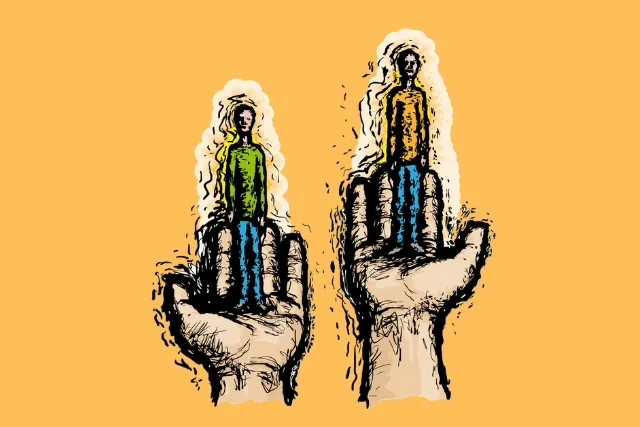
When you measure your inner life against someone else’s external highlights, you disconnect from your own path.
Happiness is deeply personal. What nourishes one person may feel empty to another.
An inside-job approach asks a different question:
- “What feels right for me, in this season of my life?”
Letting go of comparison doesn’t mean isolation. It means honoring your unique rhythms, values, and pace.
Why Happiness Requires Boundaries
Inner happiness is impossible without boundaries.
When you consistently abandon your needs to meet others’ expectations, resentment quietly erodes joy.
Boundaries protect your energy, your time, and your emotional well-being. They are not walls; they are guidelines for how you treat yourself.
Healthy boundaries sound like:
- “I need rest, even if others don’t understand.”
- “I can care without overextending.”
- “No is a complete sentence.”
Each boundary you honor sends a message inward: I matter.
That message is deeply stabilizing.
Happiness Is Built in Ordinary Moments
The image of the girl drawing a circle reminds us of something essential: happiness does not require dramatic transformation.
It grows in ordinary, repeated acts of self-attunement.
- Drinking water when you’re tired
- Saying no without guilt
- Allowing yourself to feel proud
- Choosing rest without earning it
- Letting a moment be enough
These choices may seem small, but they accumulate.
Happiness is not built in grand gestures. It is built in consistency.
You Are Allowed to Be Happy Before Everything Is Fixed
Perhaps the most radical idea of all is this: you don’t have to wait.
You don’t have to finish healing.
You don’t have to resolve every problem.
You don’t have to become a better version of yourself first.
You are allowed to experience moments of peace and joy now—even while things are imperfect.
Happiness does not mean life is easy. It means you are present, honest, and kind with yourself as life unfolds.
Coming Back to Yourself
The image does not show happiness being given. It shows happiness being claimed.
The circle drawn around the girl is not a boundary against the world—it is a reminder of where happiness begins.
Inside awareness.
Inside compassion.
Inside presence.
Inside meaning.
You don’t need to escape your life to be happy. You need to come home to yourself.
And that is work only you can do—but it is work that gently, quietly, changes everything.
Happiness is an inside job.
And you are already qualified for the role.
The Positivity Collective
The Positivity Collective is a dedicated group of curators and seekers committed to the art of evidence-based optimism. We believe that perspective is a skill, and our mission is to filter through the noise to bring you the most empowering wisdom for a vibrant life. While we are not clinical professionals, we are lifelong students of human growth, devoted to building this sanctuary for the world.