A City in Italy Has Opened Its First “Forest School” in a Public Park
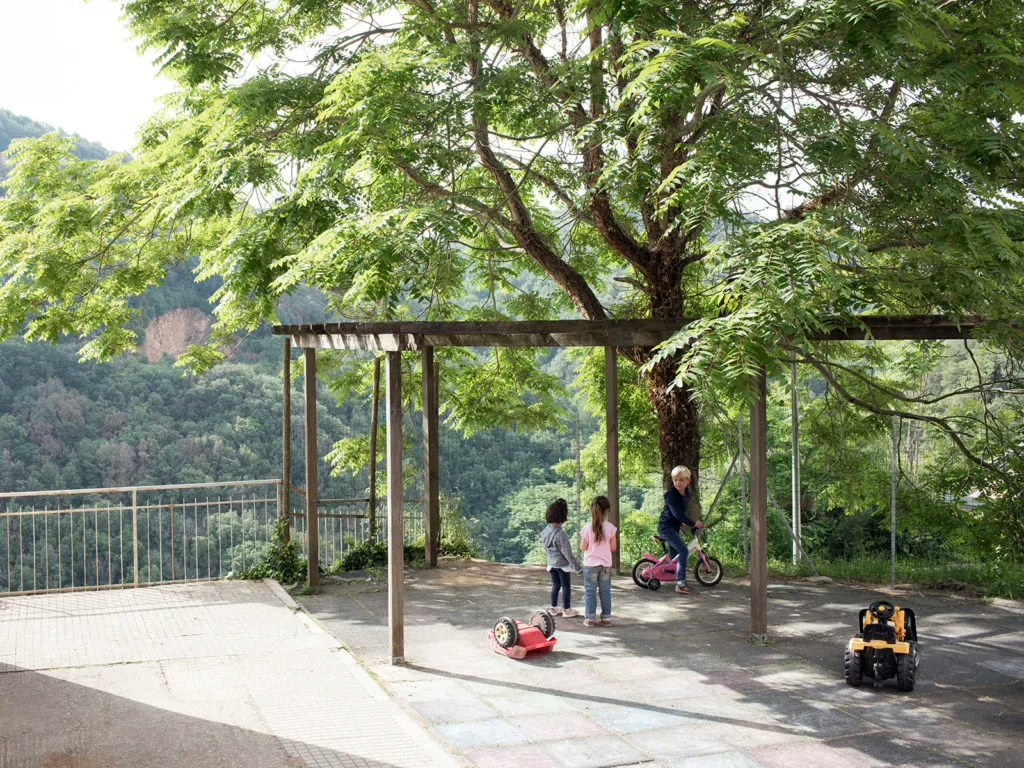
On a quiet morning in an Italian city park, children gather beneath tall trees instead of fluorescent lights. There are no desks neatly lined in rows, no bells signaling when to sit or stand.
On a quiet morning in an Italian city park, children gather beneath tall trees instead of fluorescent lights. There are no desks neatly lined in rows, no bells signaling when to sit or stand. Instead, there is birdsong, the rustle of leaves, and the gentle hum of curiosity. This is not a field trip or a temporary outdoor activity—it is school.
By opening its first forest school inside a public park, this Italian city is reimagining education in a way that feels both radical and deeply natural. At a time when childhood is increasingly shaped by screens, schedules, and indoor routines, the forest school offers something refreshingly simple: space to explore, freedom to wonder, and time to grow.
More than an educational experiment, this initiative reflects a broader cultural shift—one that values well-being, environmental connection, and community over rigid structures and constant performance.
- What Is a Forest School?
- Learning Without Walls
- Why Italy—and Why Now?
- The Science Behind Outdoor Learning
- Replacing Discipline With Responsibility
- A School That Belongs to the Community
- Teaching Environmental Stewardship From the Start
- Weather as a Teacher, Not an Obstacle
- Addressing Concerns and Misconceptions
- A Model for the Future
- A Different Kind of Success
- Rooted in Hope
What Is a Forest School?
Forest schools originated in Northern Europe, particularly in Scandinavia, where outdoor learning has long been part of early childhood education. The idea is straightforward yet powerful: children learn best when they are actively engaged with the world around them, especially the natural world.
Rather than following a fixed classroom-based curriculum, forest schools emphasize:
- Experiential learning
- Play-based exploration
- Emotional and social development
- Respect for nature
- Child-led discovery
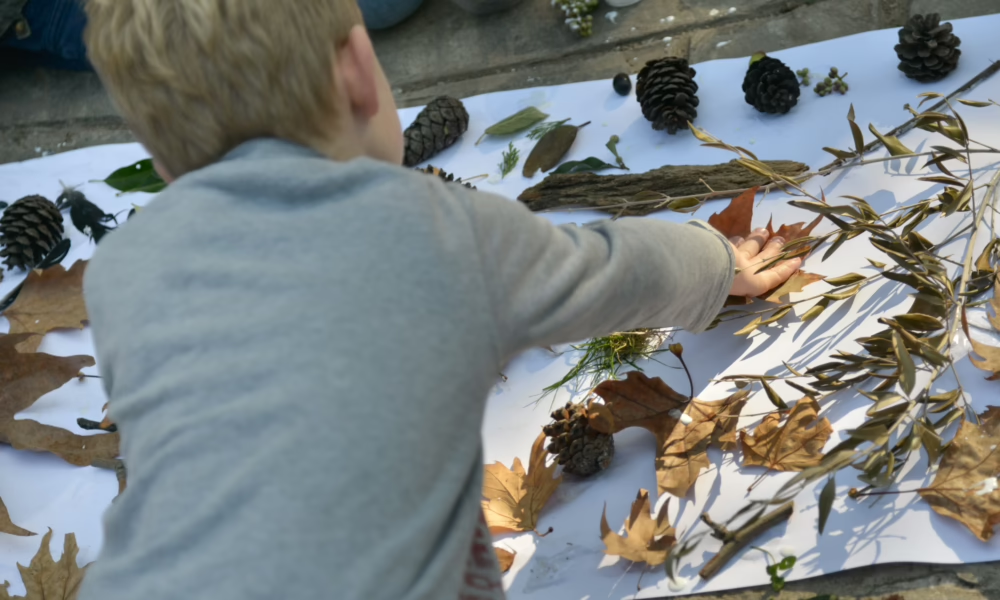
Lessons unfold organically. A fallen branch becomes a bridge, a measuring tool, or a storytelling prop. A patch of soil invites questions about insects, roots, and life beneath the surface. Learning happens through doing, observing, and interacting—not memorizing.
The Italian forest school adapts this philosophy to its local environment, blending established educational standards with outdoor immersion in a way that feels accessible and inclusive.
Learning Without Walls
At the heart of the forest school is a simple belief: education does not need walls to be meaningful.
Each day begins outdoors. Children arrive dressed for the weather, whether that means sunshine, mist, or light rain. Instead of retreating indoors at the first sign of discomfort, they are encouraged to observe and adapt. Rain becomes a lesson in movement and sound. Wind teaches balance and awareness. Seasonal changes provide a living calendar more vivid than any chart on a classroom wall.
Traditional subjects still exist—but they are woven into real-life experiences:
- Math emerges through counting stones, estimating distances, or sorting leaves by shape and size
- Science unfolds through observing insects, plant growth, and weather patterns
- Language skills grow through storytelling, conversation, and shared reflection
- Art takes shape using natural materials like bark, clay, and flowers
Teachers act as guides rather than instructors, supporting curiosity instead of controlling it. There is no pressure to rush, no fear of “getting it wrong.” Children are trusted to learn in their own way, at their own pace.
Why Italy—and Why Now?
Italy is known for its rich cultural heritage, strong family values, and close relationship with food, land, and tradition. Yet like many countries, it has faced growing concerns about childhood stress, reduced outdoor play, and the impact of overly structured education on young minds.
Parents and educators alike have noticed troubling trends:
- Children spending less time outdoors
- Rising anxiety and attention difficulties
- Decreased physical movement
- Less unstructured play
The forest school is a response to these concerns—not by rejecting education, but by rebalancing it.
By situating the school in a public park, the city sends a clear message: learning is not separate from life. Nature is not an occasional subject—it is the classroom itself.
The Science Behind Outdoor Learning
Forest schools are not just charming ideas; they are supported by a growing body of research.
Studies across Europe have found that children who spend significant time learning outdoors often show:
- Improved emotional regulation
- Greater focus and attention
- Stronger immune systems
- Better motor skills and coordination
- Higher levels of confidence and independence
Outdoor environments naturally encourage movement, collaboration, and problem-solving. Children learn to assess risks realistically—climbing carefully, balancing thoughtfully, helping one another—rather than avoiding challenge altogether.
Educators involved in the Italian project report noticeable changes within weeks. Children who were once shy become more expressive. Those who struggled to sit still find focus through movement. Conflicts are resolved more calmly, often through group discussion rather than adult intervention.
Replacing Discipline With Responsibility
One of the most striking aspects of forest school education is how it reshapes discipline. Instead of punishment, children are taught responsibility and repair.
If a conflict arises, teachers guide children through reflection:
- What happened?
- How did it make others feel?
- What can we do to fix it?
This approach builds emotional intelligence and empathy early in life. Children learn that mistakes are not failures—they are opportunities to grow.
In the open setting of a park, this philosophy becomes even more powerful. There are no walls to isolate behavior, no corners to stand in. Everything happens in shared space, reinforcing the idea that community matters.
A School That Belongs to the Community
Because the forest school operates within a public park, it naturally becomes part of the wider community. Passersby may see children building shelters, listening to stories under trees, or carefully observing ants crossing a path.
This visibility does something important: it demystifies education. Learning becomes something lived, not hidden behind gates and buildings.
Families feel welcome. Grandparents walking through the park stop to watch. Other children ask questions. Curiosity spreads.
The school also encourages families to continue outdoor learning at home—visiting parks more often, spending less time indoors, and seeing nature as a shared resource rather than a distant destination.
Teaching Environmental Stewardship From the Start
Perhaps the most lasting impact of the forest school lies in how it shapes children’s relationship with the environment.
When children learn in nature, care becomes instinctive. They notice when plants are damaged. They understand why litter doesn’t belong on the ground. They develop respect not because they are told to, but because they feel connected.
Educators say children naturally begin to:
- Protect insects instead of fearing them
- Care for plants they observe growing
- Understand ecosystems as interconnected
This early sense of stewardship has long-term implications. Children who feel connected to nature are more likely to protect it as adults—making forest schools an investment not just in education, but in the future of the planet.
Weather as a Teacher, Not an Obstacle
In many traditional schools, weather is something to be avoided. Rain cancels outdoor time. Cold keeps children inside. Heat limits movement.
Forest schools flip this perspective.
In the Italian park, weather is embraced as part of learning. Children dress appropriately and adapt their activities. A rainy day might mean observing puddles, listening to different sounds, or noticing how animals respond. A hot day encourages rest, shade, and awareness of the body’s needs.
This teaches resilience and flexibility—skills that matter far beyond childhood.
Addressing Concerns and Misconceptions
Some parents initially worry about safety, structure, or academic rigor. These concerns are understandable—and carefully addressed.
The forest school follows clear safety guidelines, with trained educators supervising all activities. Children are taught how to assess risk rather than avoid it completely.
As for academics, forest schools do not eliminate learning goals; they reframe how those goals are met. Literacy, numeracy, and critical thinking still develop—often more naturally and joyfully than in traditional settings.
Many parents who were once hesitant now describe the forest school as transformative, noting improvements not just in learning, but in their children’s happiness and confidence.
A Model for the Future
Local officials hope this forest school will inspire similar projects across Italy and beyond. It demonstrates that innovative education doesn’t require massive budgets or new buildings—just thoughtful use of existing spaces and a willingness to trust children.
As cities become denser and childhood becomes increasingly scheduled, the forest school stands as a quiet reminder: children need freedom, movement, and connection as much as they need information.
A Different Kind of Success
Perhaps the most powerful outcome of the forest school cannot be measured in tests or grades.
Success looks like:
- A child who confidently speaks their thoughts
- A group that solves problems together
- A quiet moment of wonder under a tree
- A sense of belonging—to nature, to others, to oneself
In this Italian city park, education is no longer about rushing toward the future. It is about being fully present—learning from the ground up.
Rooted in Hope
The opening of Italy’s first forest school in a public park is more than an educational milestone. It is a statement of values.
It says that childhood matters.
That nature belongs in daily life.
That learning should feel alive.
In a world searching for better ways to raise resilient, compassionate, and curious humans, this forest school offers a hopeful path forward—one leaf, one question, one discovery at a time.
The Positivity Collective
The Positivity Collective is a dedicated group of curators and seekers committed to the art of evidence-based optimism. We believe that perspective is a skill, and our mission is to filter through the noise to bring you the most empowering wisdom for a vibrant life. While we are not clinical professionals, we are lifelong students of human growth, devoted to building this sanctuary for the world.