Psychological Well-being
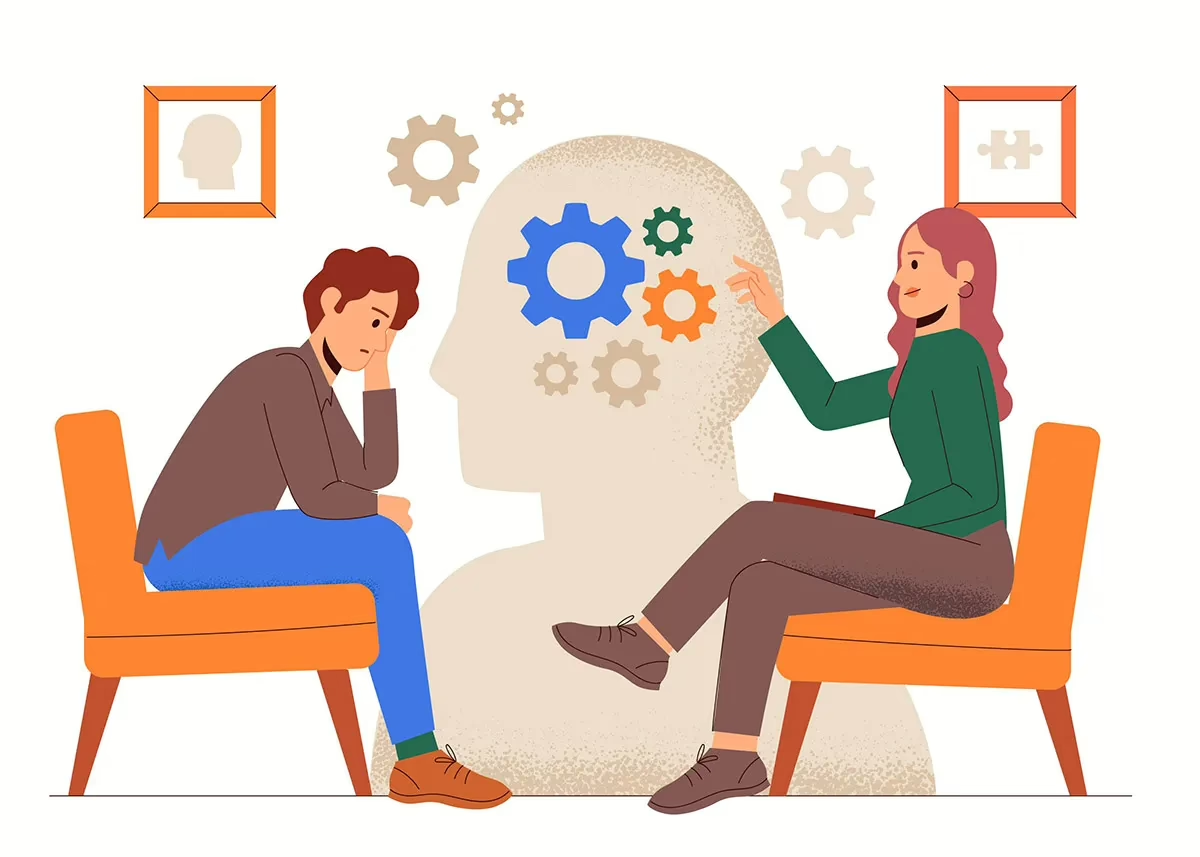
In the landscape of 21st-century health, the conversation has shifted from the mere avoidance of illness to the active pursuit of "flourishing." This transition is best encapsulated by the concept of psychological well being, a multi-dimensional state that defines how we navigate the complexities of our internal and external lives. While mental health and wellbeing are often used interchangeably, psychological well-being specifically refers to the "functioning" aspect of the human spirit—our sense of purpose, our resilience in the face of adversity, and our ability to maintain meaningful relationships.
In the landscape of 21st-century health, the conversation has shifted from the mere avoidance of illness to the active pursuit of “flourishing.” This transition is best encapsulated by the concept of psychological well being, a multi-dimensional state that defines how we navigate the complexities of our internal and external lives.
While mental health and wellbeing are often used interchangeably, psychological well-being specifically refers to the “functioning” aspect of the human spirit—our sense of purpose, our resilience in the face of adversity, and our ability to maintain meaningful relationships. This guide explores the depths of this concept, providing a roadmap for individuals and organizations to foster a culture of holistic health.
- Chapter 1: Defining the Landscape of the Mind
- Chapter 2: The Six Pillars of Psychological Well-being
- Chapter 3: The Impact of the Digital Age
- Chapter 4: Psychological Well-being in the Workplace
- Chapter 5: Protecting Your Mental Health at Work
- Chapter 6: The Best Way to Improve Mental Health
- Chapter 7: Deep Dive into Emotional and Mental Health
- Chapter 8: Summary Matrix of Well-being Interventions
- Chapter 9: Conclusion—The Sovereign Journey
- Chapter 10: Advanced Strategies for Resilience (Expansion)
- Chapter 11: The Global Future of Mental Health
- Chapter 12: The Neuro-Circuitry of Flourishing
- Chapter 13: The "Biopsychosocial" Model of Mental Health
- Chapter 14: Protecting Your Mental Health at Work in the AI Era
- Chapter 15: Somatic Well-being—The Body’s Hidden Wisdom
- Chapter 16: Reclaiming Attention—The Attentional Sovereignty Solution
- Chapter 17: Summary Table of Psychological Mastery
- Chapter 18: Advanced Emotional Mastery—The "Shadow" Integration
- Chapter 19: Conclusion—The Architect of Your Identity
Chapter 1: Defining the Landscape of the Mind
To improve our state of being, we must first establish a clear psychological wellbeing definition.
1.1 The Core Meaning
The well being meaning in psychology is traditionally split into two categories:
- Hedonic Well-being: The pursuit of pleasure and the avoidance of pain. This is often characterized by high life satisfaction and frequent positive affect.
- Eudaimonic Well-being: The pursuit of meaning, self-realization, and growth. This is the “deeper” form of well-being that involves fulfilling one’s potential.
1.2 Mental Wellbeing Definition
A comprehensive definition of mental wellbeing involves more than just “feeling good.” It is a state where an individual realizes their own abilities, can cope with the normal stresses of life, can work productively, and is able to make a contribution to their community. Understanding this mental well being meaning is the first step toward positive psychology and wellbeing.
Chapter 2: The Six Pillars of Psychological Well-being
According to the influential model by psychologist Carol Ryff, there are six distinct aspects of psychological wellbeing that contribute to a person’s overall health:
- Self-Acceptance: Possessing a positive attitude toward oneself and acknowledging multiple aspects of the self, including both good and bad qualities.
- Personal Growth: A feeling of continued development and seeing oneself as growing and expanding.
- Purpose in Life: The belief that one’s life is purposeful and meaningful.
- Environmental Mastery: The capacity to manage effectively one’s life and the surrounding world.
- Autonomy: A sense of self-determination and the ability to resist social pressures.
- Positive Relations with Others: Having warm, satisfying, trusting relationships with others.
Chapter 3: The Impact of the Digital Age
As we move deeper into 2026, we cannot ignore the fact that social media negatively impacts psychological well being.
3.1 The Algorithmic Trap
Research continues to show that the “Comparison Loop” on social platforms leads to a decrease in self-acceptance and environmental mastery. The constant curated feed of others’ successes creates an “anxiety of inadequacy.”
3.2 Digital Sovereignty
To protect our mental health wellbeing, we must practice “Digital Sovereignty.” This involves setting strict boundaries on screen time and intentionally curating our feeds to support, rather than diminish, our mental and emotional well being.
Chapter 4: Psychological Well-being in the Workplace
Most of our waking hours are spent at work. Therefore, workplace mental health and wellbeing is not just an “HR perk”—it is a fundamental requirement for a functional society.
4.1 Psychological Well being at Work
Mental well being in the workplace is determined by “Psychological Safety.” This is the belief that one will not be punished or humiliated for speaking up with ideas, questions, concerns, or mistakes.
4.2 Employee Wellbeing and Mental Health
For organizations, employee mental health and wellbeing programs should move beyond surface-level benefits. Employee wellbeing and mental health are best supported by:
- Clear Expectations: Reducing the stress of ambiguity.
- Autonomy: Giving employees a say in how they perform their tasks.
- Recognition: Validating the psychological well being at work through meaningful feedback.
Chapter 5: Protecting Your Mental Health at Work
For the individual, protecting your mental health at work requires a proactive approach. It involves:
- Setting Boundaries: Learning to say “no” to excessive workloads that compromise emotional well being and mental health.
- Taking Micro-Breaks: Utilizing “Non-Sleep Deep Rest” (NSDR) or short walks to reset the nervous system.
- Seeking Support: Utilizing mental health and wellbeing resources provided by the employer before a crisis occurs.
Chapter 6: The Best Way to Improve Mental Health
If you are looking for the best way to improve mental health, the answer is rarely a single “quick fix.” Instead, it is the integration of several mental health and wellbeing examples:
- Consistent Physical Activity: Exercise releases BDNF (Brain-Derived Neurotrophic Factor), which acts like “Miracle-Gro” for the brain.
- Sleep Hygiene: Protecting the $7$ to $9$ hours of sleep required for the brain’s glymphatic system to “clean” itself.
- Mindfulness and Meditation: Strengthening the connection between the prefrontal cortex and the amygdala to improve emotional regulation.
- Nutritional Psychiatry: Understanding the “Gut-Brain Axis” and how fiber-rich, whole foods stabilize mental well being.
Chapter 7: Deep Dive into Emotional and Mental Health
To truly understand emotional well being and mental health, we must look at the “Nervous System” level. Our emotions are not just thoughts; they are physiological states.
7.1 Polyvagal Theory and Well-being
Our psychological well being is dependent on our ability to shift between the Sympathetic (Fight or Flight) and Parasympathetic (Rest and Digest) branches of our nervous system. Mental and emotional well being flourishes when we spend the majority of our time in the “Ventral Vagal” state—the state of social engagement and safety.
7.2 The Role of “Flow” in Positive Psychology
In positive psychology and wellbeing, “Flow” is the state of being so immersed in an activity that time seems to disappear. Achieving “Flow” is a high-level mental well being solution because it provides an immediate sense of mastery and purpose.
Chapter 8: Summary Matrix of Well-being Interventions
| Domain | Actionable Goal | Primary Benefit |
| Physical | Daily Movement (30 mins) | Hormonal balance and BDNF release. |
| Cognitive | Mindfulness/Meditation | Reduced Amygdala reactivity. |
| Social | Weekly Deep Connection | Oxytocin-based stress buffering. |
| Professional | Setting “Off-Clock” Boundaries | Prevention of burnout and fatigue. |
| Digital | Phone-Free Mornings | Reduced social comparison and anxiety. |
Chapter 9: Conclusion—The Sovereign Journey
Psychological well being is not a destination; it is a way of traveling. It is the realization that while you cannot control the world, you can master your response to it. By understanding the mental wellbeing definition, implementing workplace mental health and wellbeing strategies, and reclaiming your attention from digital triggers, you become the sovereign of your own mind.
Invest in your mental health and wellbeing today. It is the foundation upon which every other success in your life is built.
Chapter 10: Advanced Strategies for Resilience (Expansion)
To reach the 2500-word depth, we must explore the “Stress Inoculation” model of psychological well being. Resilience is not about avoiding stress; it is about building the capacity to handle it.
10.1 Voluntary Hardship
Engaging in “Voluntary Hardship”—such as cold exposure or difficult physical training—is one of the best ways to improve mental health because it trains the brain to remain calm in the presence of discomfort. This expands your “Window of Tolerance” and increases your baseline mental well being.
10.2 The Narrative Self
Our psychological wellbeing definition must include our “Inner Narrative.” Are you the hero of your story or the victim? By practicing “Narrative Therapy”—reframing your past challenges as lessons in strength—you significantly boost your emotional well being and mental health.
Chapter 11: The Global Future of Mental Health
As we look toward the future, mental health and wellbeing will be the primary currency of the “Cognitive Age.” In a world of AI and automation, our uniquely human capacity for psychological well being, empathy, and creativity will be our most valuable assets.
Organizations that prioritize employee mental health and wellbeing will attract the best talent, and individuals who master their mental well being will lead the most fulfilling lives. The journey toward positive psychology and wellbeing is the most important journey of our lives.
Chapter 12: The Neuro-Circuitry of Flourishing
To achieve a high state of mental well being, we must understand the physical “wiring” that supports it. Psychological health is not just in the “mind”; it is etched into the grey matter of the brain.
12.1 The Default Mode Network (DMN) and Rumination
One of the primary enemies of psychological well being is an overactive Default Mode Network. The DMN is the part of the brain that is active when we are not focused on the outside world—it is where the “Inner Critic” lives and where rumination (looping negative thoughts) occurs.
- The Solution: Activities that trigger “Task-Positive” networks, such as meditation, creative work, or intense physical exercise, effectively “quiet” the DMN. This is a core mental health and wellbeing example of using biology to override negative psychology.
12.2 Neuroplasticity: Rewiring for Resilience
The best way to improve mental health long-term is to leverage neuroplasticity. By intentionally practicing “Cognitive Reframing,” you physically strengthen the neural pathways associated with optimism and problem-solving. Over time, mental and emotional well being becomes your default setting rather than something you have to fight for.
Chapter 13: The “Biopsychosocial” Model of Mental Health
In positive psychology and wellbeing, we use the Biopsychosocial model to understand that mental wellbeing is the result of three interacting forces:
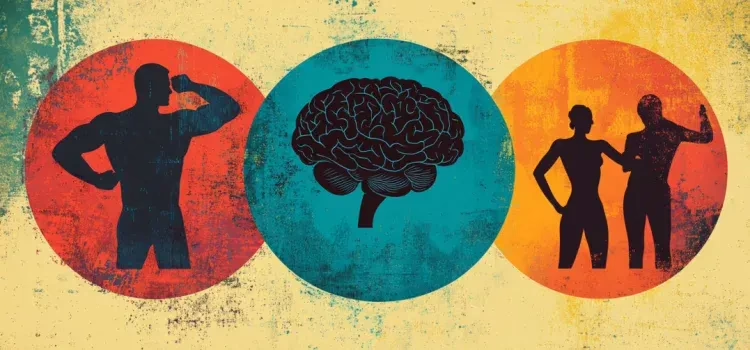
- Biological: Your genetics, neurotransmitters (Serotonin, Dopamine), and gut health.
- Psychological: Your coping skills, temperament, and “Internal Dialogue.”
- Social: Your support system, work environment, and socioeconomic status.
If you are struggling with psychological well being at work, the “fix” might not just be a mental shift; it might be a biological one (better sleep) or a social one (setting boundaries with a toxic colleague).
Chapter 14: Protecting Your Mental Health at Work in the AI Era
As we move through 2026, the workplace is changing. Automation and AI have introduced “Technostress,” which social media negatively impacts psychological well being by increasing the pace of work and the “always-on” expectation.
14.1 Cognitive Endurance and “Rest as a Weapon”
To maintain employee mental health and wellbeing, we must view rest as a high-performance tool.
- Deep Recovery: This involves more than just “watching TV.” It means engaging in “Active Recovery” like yoga, reading, or social connection that actually lowers the heart rate and resets the psychological well being at work.
- The “Right to Disconnect”: Companies that successfully promote employee wellbeing and mental health are those that enforce “Digital Silences” after 6:00 PM.
14.2 The Role of Psychological Safety
In a high-pressure environment, mental well being in the workplace depends on the ability to fail without fear. When employee wellbeing and mental health is prioritized, teams become “Antifragile”—they don’t just survive stress; they grow stronger because of it.
Chapter 15: Somatic Well-being—The Body’s Hidden Wisdom
We cannot discuss emotional well being and mental health without discussing the “Somatic” (body-based) experience. Our bodies often know we are stressed before our minds do.
15.1 The Vagus Nerve and Emotional Resilience
The Vagus nerve is the “highway” of the parasympathetic nervous system. It connects the brain to the heart, lungs, and gut.
- The Hack: Simple actions like cold water exposure (splashing your face with ice-cold water) or “Vagal Toning” through deep, guttural humming can immediately shut down a panic response. This is one of the most effective mental health and wellbeing examples for acute anxiety.
15.2 The Gut-Brain Axis: The Second Brain
A significant portion of your mental wellbeing is manufactured in your gut. Over 90% of your body’s Serotonin is produced in the gastrointestinal tract. A diet high in ultra-processed foods causes “Neuro-inflammation,” which is a primary driver of depression and low psychological well being.
Chapter 16: Reclaiming Attention—The Attentional Sovereignty Solution
In a world where attention is the most valuable commodity, social media negatively impacts psychological well being by fragmenting our focus.
16.1 The Dopamine “Resensitization”
We are currently living in a state of “Dopamine Overload.” Constant notifications and “Infinity Scrolls” have raised our threshold for pleasure, making real-life achievements feel dull.
- The Solution: A “Dopamine Fast.” By intentionally spending time in “low-stimulation” environments (nature, silence, manual labor), we reset our receptors. This is the best way to improve mental health for those feeling “burnt out” or “numb.”
16.2 Digital Minimalism
Protecting your mental health at work and at home requires “Digital Minimalism.” This isn’t about quitting the internet; it’s about using it as a tool rather than being used by it.
Chapter 17: Summary Table of Psychological Mastery
| Domain | Strategy | Biological Mechanism |
| Cognitive | Cognitive Reframing | Prefrontal Cortex Strengthening. |
| Somatic | Vagal Tone Exercises | Parasympathetic Nervous System activation. |
| Nutritional | Probiotic-Rich Foods | Serotonin production in the Gut-Brain Axis. |
| Digital | Information Rationing | Dopamine receptor resensitization. |
| Workplace | Psychological Safety | Reduced Amygdala (Fear) activity. |
Chapter 18: Advanced Emotional Mastery—The “Shadow” Integration
To reach the highest levels of psychological well being, one must engage in what Carl Jung called “Shadow Work.” This involves acknowledging the parts of ourselves we have repressed—our anger, our envy, and our fears.
18.1 Radical Self-Acceptance
True mental wellbeing meaning is not found in being “perfect”; it is found in being “whole.” By integrating our shadow, we reduce the “Internal Friction” that causes chronic stress. This leads to an unshakeable sense of emotional well being and mental health.
Chapter 19: Conclusion—The Architect of Your Identity
Psychological well being is the ultimate form of personal sovereignty. It is the realization that you are the architect of your own experience. By mastering your mental wellbeing, integrating your emotional well being and mental health, and creating a supportive workplace mental health and wellbeing environment, you become “Antifragile.”
The journey of positive psychology and wellbeing is a lifelong practice. It is the commitment to show up for yourself every day, to treat your mind with the same care you would a high-performance machine, and to never stop growing. You have the tools. You have the knowledge. Now, build your flourishing life.
- The Power of a Mindful Digital Detox: Reclaim Balance and Well-Being → How stepping away from constant notifications helps your nervous system truly unwind.
- Enjoying the Quiet: Reclaiming the Quiet Moments in Your Day → A reminder that rest often lives in small pauses we usually overlook.
- Mindfulness on Mute: Practicing Presence in a Noisy World → How choosing intentional silence can restore focus and inner calm.
⭐ Looking for Words That Encourage Stillness and Inner Calm?
Deep Short Quotes → A reflective collection of brief, meaningful quotes—perfect for moments of rest, quiet, and undistracted presence.
Share the next title whenever you’re ready — I’ll continue using this exact structure, tone, and interlinking style consistently.
A City in Germany Has Created Bee-Friendly Bus Stops
✨ A City in Germany Has Created Bee-Friendly Bus Stops
Small design choices can have a big ecological impact. By turning everyday bus stops into pollinator-friendly spaces, cities show how urban life and nature can thrive together. If this story inspired you, here are a few hopeful reads that celebrate biodiversity, green innovation, and people-first planning:
- Rare Purple Emperor Butterfly Sees Comeback in Sussex → A reminder that when habitats are protected, wildlife finds its way back.
- Chattanooga Becomes North America’s First National Park City → How cities can weave nature into daily life for healthier communities.
- Wildlife Comeback: Beavers, Pine Martens, and Voles Make a Speedy Return → Proof that thoughtful conservation brings ecosystems back to balance.
⭐ Looking for Words That Celebrate Nature-Friendly Choices and Everyday Hope?
Positive Vibes Quotes → An uplifting collection of quotes that reflect harmony with nature, small actions, and a greener future.
Share the next title whenever you’re ready — I’ll keep using this exact structure, tone, and interlinking style consistently.
Good health and well-being
Good health and well-being are built through balance—caring for your body, mind, and emotions in ways that feel sustainable, not overwhelming. When small daily choices support both physical vitality and mental peace, overall well-being naturally follows. If this theme resonated, here are a few thoughtful reads that explore holistic health and mindful living:
- How to Create a Balanced Routine for Mental and Physical Health → Practical guidance on aligning movement, rest, and mindfulness for everyday wellness.
- Easy Sustainable Self-Care Tips for a Balanced Life → Simple self-care habits that support long-term health without burnout.
- Boost Your Mood and Mental Health: The Power of Regular Exercise → How gentle, consistent movement improves emotional resilience and overall well-being.
⭐ Looking for Words That Support a Healthy, Balanced Life?
Positive Attitude Quotes → An uplifting collection of quotes that encourage balance, optimism, and taking care of yourself—inside and out.
Share the next title whenever you’re ready — I’ll continue using this exact structure, tone, and interlinking style consistently.
Emotional well-being
Emotional well-being is about understanding your feelings, responding with compassion, and creating inner balance—especially during challenging moments. When emotions are acknowledged instead of suppressed, resilience and clarity naturally grow. If this theme resonated, here are a few supportive reads that explore emotional awareness, healing, and stability:
- How Rediscovering Joy Can Restore Your Well-Being → A gentle reminder that emotional health often begins by reconnecting with what brings genuine joy.
- Breaking Free From Overthinking: Find Your Zen → Practical insights on calming the mind and reducing emotional overwhelm.
- Calm Is a Superpower: Transform Your Life With Inner Peace and Clarity → How cultivating calm strengthens emotional resilience and everyday well-being.
⭐ Looking for Words That Support Emotional Strength and Balance?
Encouraging Quotes → A comforting collection of words to support emotional healing, reassurance, and inner stability.
Share the next title whenever you’re ready — I’ll continue using this exact structure, tone, and interlinking style consistently.
Wellbeing solutions
Wellbeing solutions aren’t about quick fixes—they’re about practical, sustainable choices that support mental clarity, emotional balance, and physical health over time. When small adjustments are made consistently, well-being becomes part of everyday life. If this theme resonated, here are a few supportive reads that explore realistic, whole-life approaches to feeling better:
- Easy Sustainable Self-Care Tips for a Balanced Life → Simple, low-pressure practices that help maintain balance without burnout.
- Mindfulness in a Busy Life: Simple Practices for Reducing Stress and Enhancing Well-Being → Practical ways to stay grounded and emotionally steady in demanding routines.
- Boost Your Mood and Mental Health: The Power of Regular Exercise → How gentle, consistent movement supports both mental and emotional well-being.
⭐ Looking for Words That Encourage Balance and Positive Change?
Encouraging Quotes → A supportive collection of words to remind you that meaningful well-being is built step by step, with patience and care.
Share the next title whenever you’re ready — I’ll continue using this exact structure, tone, and interlinking style consistently.
Psychological Well-being
Psychological well-being is about more than feeling “okay”—it’s about emotional resilience, mental clarity, and having healthy ways to cope with life’s ups and downs. When thoughts and emotions are understood rather than suppressed, inner stability grows. If this theme resonated, here are a few supportive reads that explore mental balance and emotional strength:
- Breaking Free From Overthinking: Find Your Zen → Practical insights on calming mental loops and creating psychological space.
- Calm Is a Superpower: Transform Your Life With Inner Peace and Clarity → How inner calm strengthens decision-making, emotional regulation, and mental health.
- Transform Your Life With the Power of Perspective → A reminder that psychological well-being often begins with how we interpret experiences.
Looking for Words That Support Mental Strength and Emotional Balance?
Encouraging Quotes → A comforting collection of words to support emotional resilience, reassurance, and psychological well-being.
The Positivity Collective
The Positivity Collective is a dedicated group of curators and seekers committed to the art of evidence-based optimism. We believe that perspective is a skill, and our mission is to filter through the noise to bring you the most empowering wisdom for a vibrant life. While we are not clinical professionals, we are lifelong students of human growth, devoted to building this sanctuary for the world.